
Sample reportsSubject: stevemacgregor.com
See the report before you buy one
These pages come from a real report on my own photography website. One report has three readers, so pick the one that sounds like you.
For the owner: two pages, read in five minutes
The Owner Brief says what's wrong, why it matters to the business, and what to do first. The Executive Summary adds the scorecard and what's already working. You don't need to read the rest unless something concerns you.
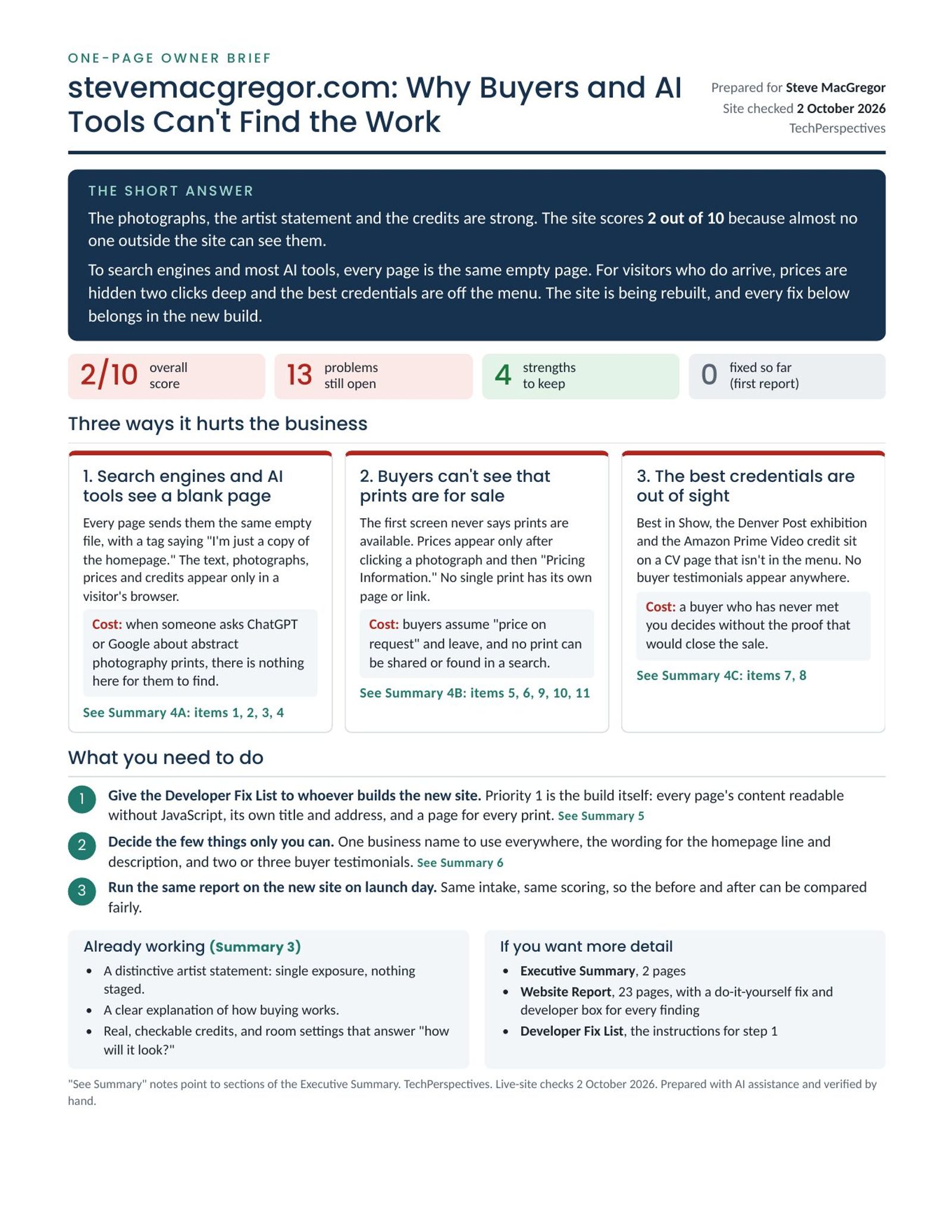
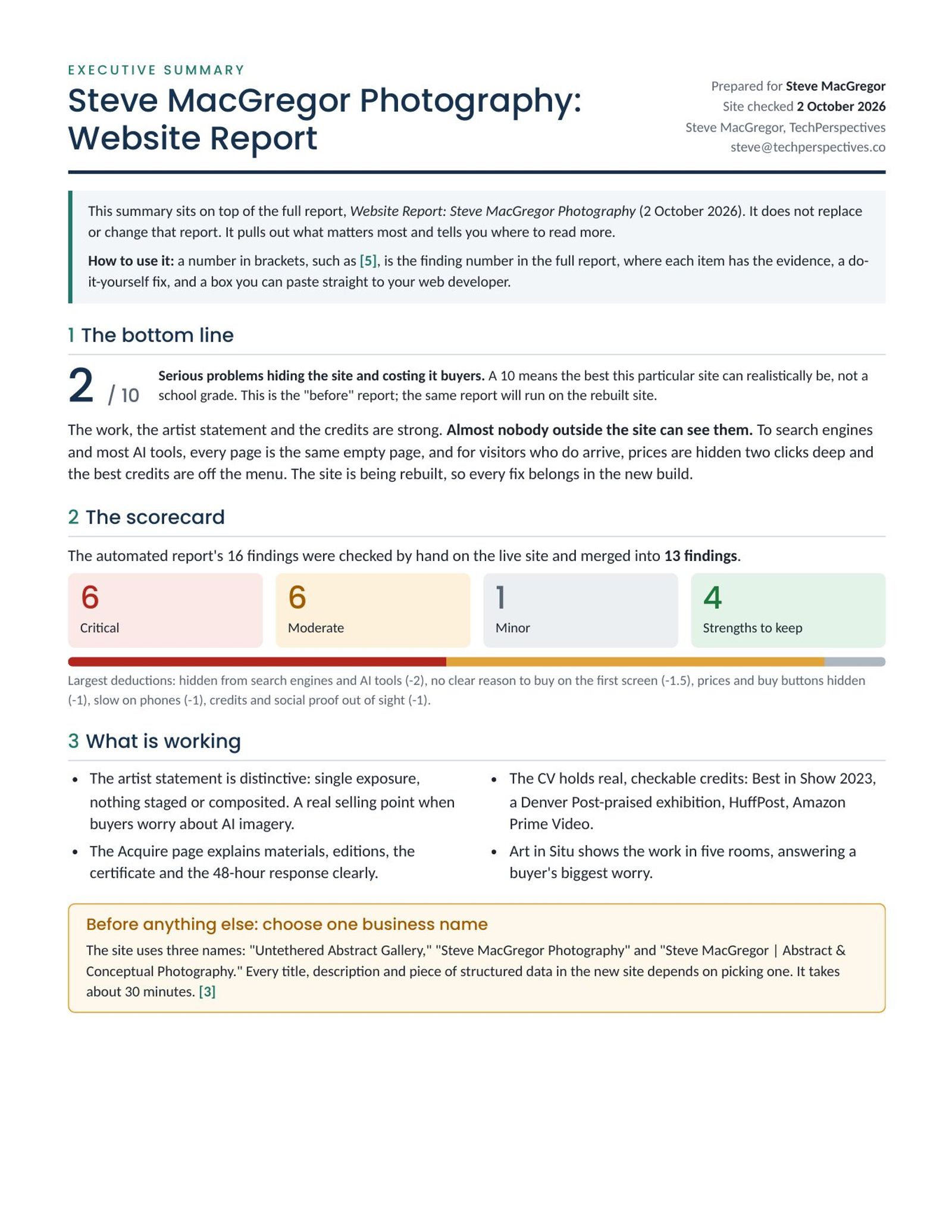
Click any page to see it full size. From an October 2026 report. Reports keep improving, so yours will reflect the latest version. Want to see a complete report? Ask me on the call.
For whoever manages the site: every finding, and a tracker
The full report explains each finding: what I found, why it matters, and how to fix it. The tracker turns it into a list you can work through. Try it below.
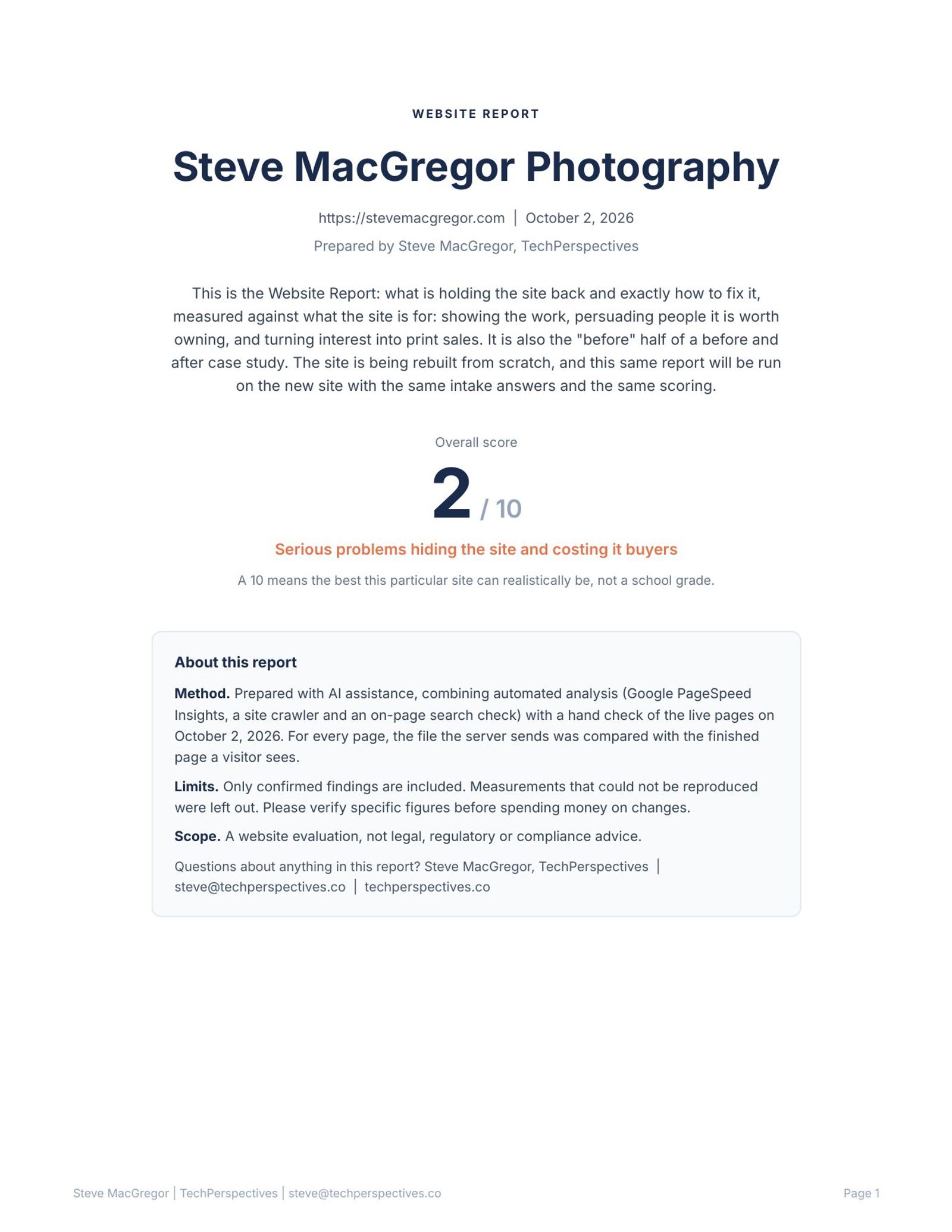
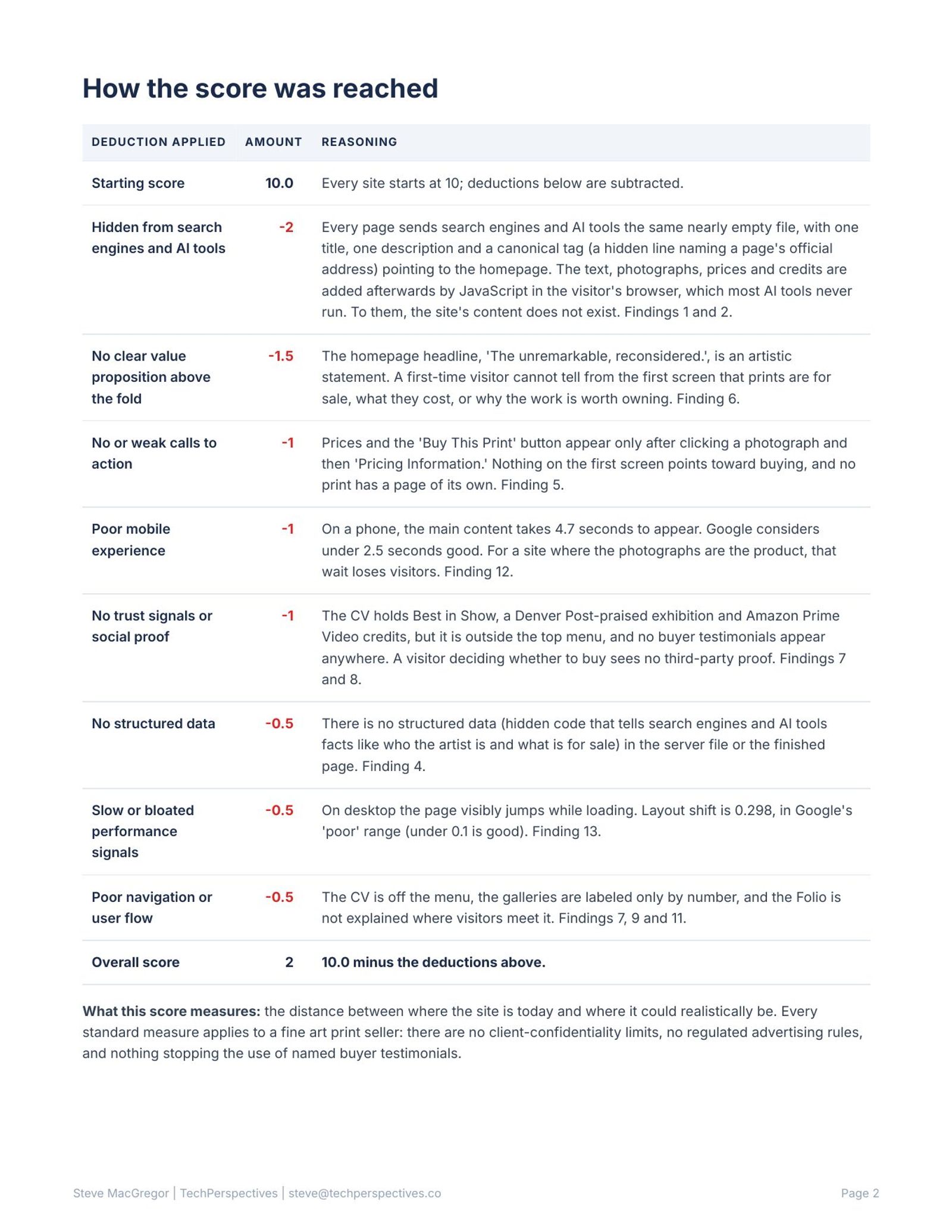
Click any page to see it full size. From an October 2026 report. Reports keep improving, so yours will reflect the latest version. Want to see a complete report? Ask me on the call.
The tracker
This works just like the tracker clients get. Click an item to open it, or click a colored box to show only those items.
0 of 13 fixed, 0 partly fixed, 13 still open.
Search engines and AI tools cannot see the site
- 1Still open
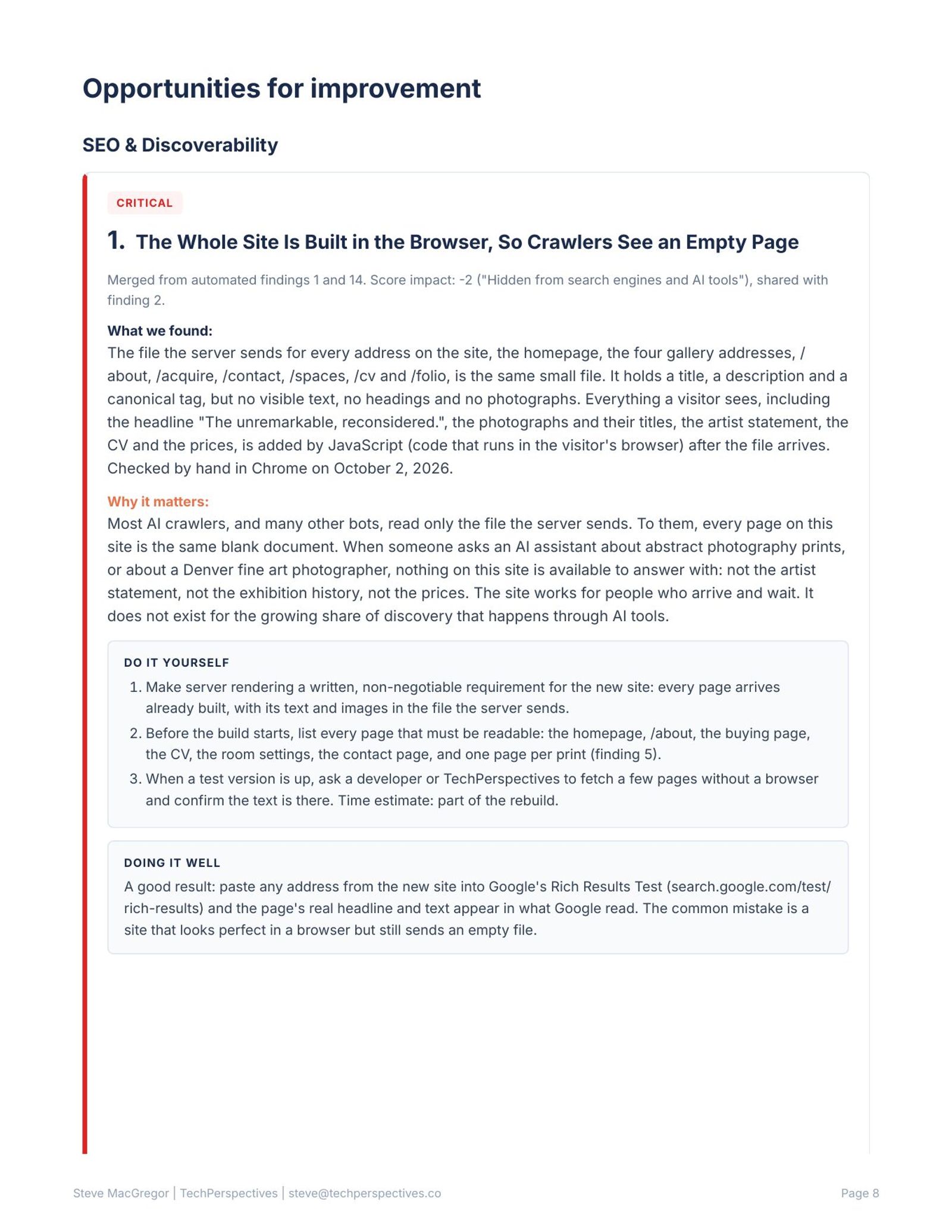
critical The whole site is built in the browser, so crawlers see an empty page
What we saw on 2 October 2026The server copy for every address on the site (the homepage, the four gallery addresses, /about, /acquire, /contact, /spaces, /cv and /folio) is the same small file. It holds a title, a description and a canonical tag, but no visible text, no headings and no images. Everything a visitor sees, including the headline "The unremarkable, reconsidered.", the photographs and their titles, the artist statement, the CV and the prices, is added by JavaScript after the page arrives.
Why it mattersMost AI crawlers, and many other bots, only read the server copy. To them, every page on this site is the same blank document. When someone asks an AI assistant about abstract photography prints, or about a Denver fine art photographer, nothing on this site is available to it: not the artist statement, not the exhibition history, not the price range. The site works for people who arrive and wait. It does not exist for the growing share of discovery that happens through AI tools.
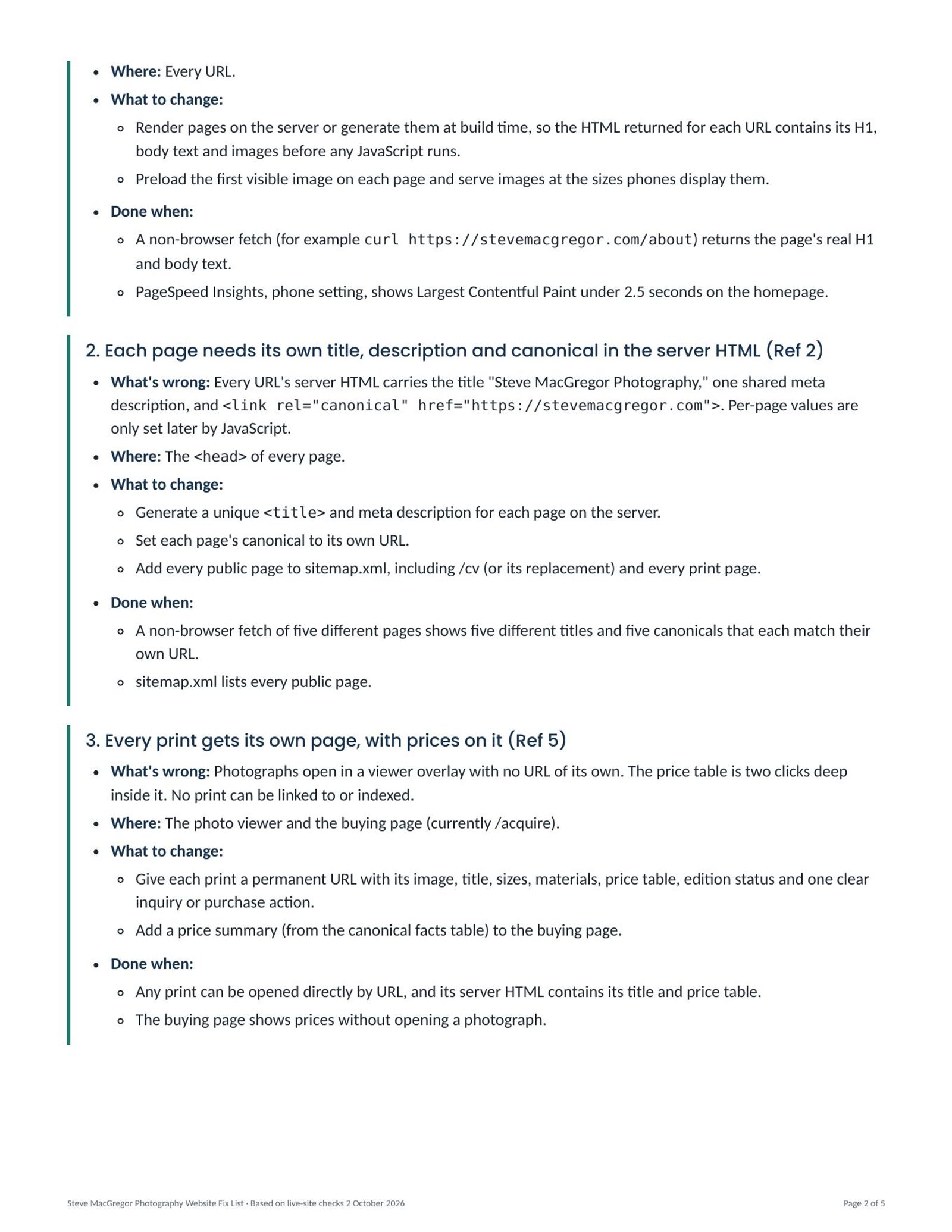
The fixBuild the new site with server rendering (or by generating each page ahead of time), so that the server copy of every page already contains its headline, text and images before any JavaScript runs.
Time estimate: Part of the rebuild.
Score impact-2 ("Hidden from search engines and AI tools"), shared with finding 2.
Status history- 2 October 2026: Still open
- 2Still open
critical Every page tells search engines it is the homepage
What we saw on 2 October 2026The server copy of every page carries the same title ("Steve MacGregor Photography"), the same meta description, and a canonical tag pointing to https://stevemacgregor.com. That includes /about, /acquire, /contact, /spaces, /cv and the four gallery addresses listed in the sitemap. Correct page titles and canonical tags (for example "Steve MacGregor | Artist" for /about) are added later by JavaScript, too late for crawlers that read only the server copy.
Why it mattersA canonical tag pointing to the homepage tells search engines "this page is just a copy of the homepage, ignore it." Every page on the site sends that message, so the artist statement, the CV, the buying information and the room settings are all effectively removed from search results.
The fixIn the new site, the server copy of each page must carry its own title, its own description and a canonical tag pointing to its own address.
Time estimate: 30 minutes on launch day.
Score impactPart of the -2 ("Hidden from search engines and AI tools") deduction, shared with finding 1.
Status history- 2 October 2026: Still open
- 3Still open
critical Three names for one business, and a description aimed at the wrong audience
What we saw on 2 October 2026- The brand in the header and footer is "Untethered Abstract Gallery." The server title is "Steve MacGregor Photography." The title set by JavaScript is "Steve MacGregor | Abstract & Conceptual Photography." - The meta description, used on every page, reads: "Professional abstract urban photography by Steve MacGregor. Focused on reductive, in-camera compositions, intimate landscapes, and urban decay." It does not say prints are for sale and gives no price signal.
Why it mattersSearch engines and AI tools work out who a business is by matching its name across the page title, the brand, the content and outside mentions. Three different names make that harder. A collector who hears "Untethered Abstract Gallery" and searches for it lands on a site whose title says something else, and a description written about genre rather than prints gives a buyer no reason to click.
The fixChoose one name and use it everywhere: the header, every page title, the description, the social sharing title and any outside profiles. A name that includes "Steve MacGregor" connects the site to the press coverage and exhibition records that already carry that name. Then rewrite the description for a buyer, for example: "Fine art abstract photography prints by Steve MacGregor, Denver. Single exposure, made in camera. Signed prints in Fine Art Paper, Brushed Metal and Gallery Acrylic from $95." Each page should then get its own description.
Time estimate: 30 minutes to decide the name, 1 to 2 hours for descriptions.
Score impactNone directly.
Status history- 2 October 2026: Still open
- 4Still open
moderate No structured data about the artist or the prints
What we saw on 2 October 2026There is no structured data of any kind, in the server copy or in the finished page.
Review noteThe automated report recommended "LocalBusiness" structured data. That type is meant for businesses with a storefront customers visit, and this business sells online with no Google Business Profile. Structured data describing the artist as a person fits better.
Why it mattersStructured data hands search engines and AI tools the key facts directly, in a form they do not have to interpret. It is the clearest way to connect the name Steve MacGregor to the work, the credits and the prints.
The fixIn the server copy, add "Person" structured data for Steve MacGregor (name, web address, "Fine Art Photographer," Denver, and links to any outside profiles), plus a short "WebSite" block with the chosen business name. Once each print has its own page (Item 5), add "Product" structured data to each print page with its title, image, sizes and prices.
Time estimate: 2 to 3 hours for the developer.
Score impact-0.5 ("No structured data").
Status history- 2 October 2026: Still open
Buyers cannot easily see what is for sale or how to buy
- 5Still open
critical Prints have no pages of their own, and prices are buried in an overlay
What we saw on 2 October 2026- Clicking any photograph opens a viewer on top of the gallery with Pricing Information, Buy This Print, Your Comments, Add to Folio and View Folio. The web address does not change. - The price table only appears after clicking a photograph and then "Pricing Information." It runs from $95 (8.5 by 8.5 inch Fine Art Paper) to $2,200 (30 by 30 inch limited edition Acrylic). The 24 by 24 inch and 30 by 30 inch sizes are limited editions of 15. - The Acquire page describes formats and editions in words and sends buyers to the galleries to find prices. - Because the viewer has no address, no single print can be linked to, bookmarked, shared or found in a search.
Why it mattersA buyer considering $95 to $2,200 almost always wants to check the price first. If prices take a hidden two-step path, many assume "price on request" and leave. A buyer who wants to send a specific print to a partner for a second opinion cannot link to it. And every print without its own page is one less way for a search engine or AI tool to find the work.
The fixGive every print its own page at a permanent address, showing the image, its title, sizes, materials, the price table, edition status and one clear way to ask about or buy it. Add a short price summary to the Acquire page so a buyer gets a price signal without hunting.
Time estimate: Part of the rebuild.
Score impact-1 ("No or weak calls to action").
Status history- 2 October 2026: Still open
- 6Still open
critical The opening headline is a statement, not an invitation
What we saw on 2 October 2026The homepage headline is "The unremarkable, reconsidered." The line below reads "A curation of Steve MacGregor's in camera abstract photography exploring the boundaries of perception, texture and temporal distortions." The only instruction is "Click on any photograph to begin." Nothing on the first screen says prints are for sale, gives a price, or mentions the artist's credits. In an 8-second first look, a visitor can tell this is a photography portfolio, but not why to care or what to do next.
Why it mattersThe first screen is where a new visitor decides whether to stay. A collector arriving without knowing the artist has no signal that buying is possible, so the site depends on visitors finding the buying path on their own.
The fixKeep the headline; it is distinctive. Add one short line that bridges to the offer, for example "Signed fine art prints, single exposure, from $95," and a second link beside "Click on any photograph to begin" that goes to how to buy.
Time estimate: 30 minutes, plus deciding the wording.
Score impact-1.5 ("No clear value proposition above the fold").
Status history- 2 October 2026: Still open
- 9Still open
moderate Numbered gallery labels give visitors no reason to explore
What we saw on 2 October 2026The galleries are labeled Gallery I, Gallery II, Gallery III and Gallery IV, in the tabs and in the menu, with no description of what each holds. Gallery I holds 12 photographs.
Why it mattersOnline, a visitor cannot glance into a room to see what is inside. Numbered labels make them click through everything, and the longer it takes to find a piece they like, the more likely they leave first.
The fixGive visitors a reason to choose a path into the work, such as a short word or phrase for each group that describes its character, so they can head toward what interests them.
Time estimate: An hour to write labels.
Score impactPart of -0.5 ("Poor navigation or user flow").
Status history- 2 October 2026: Still open
- 10Still open
minor "Art in Situ" is not self-explanatory
What we saw on 2 October 2026The menu item "Art in Situ" leads to /spaces, the page showing the work in five room settings. "In situ" is an art-world term many home and office buyers will not recognize.
Why it mattersThis page answers the buyer's biggest hesitation. A label that does not say so means fewer visitors open it.
The fixLabel it by what the page does for the buyer, for example "See it in a room." The address can stay the same.
Time estimate: 10 minutes.
Score impactNone.
Status history- 2 October 2026: Still open
- 11Still open
moderate The Folio is not explained
What we saw on 2 October 2026"Folio" sits in the top menu. /folio is a page titled "Your curated pieces" where a visitor's saved photographs appear, with Print / Download PDF, Comment, Purchase and Back to Gallery buttons. What the Folio is for is explained only on the Acquire and Contact pages.
Why it mattersThe Folio is a genuine difference from a standard shopping cart: it invites a conversation. But a feature visitors do not understand does not get used.
The fixExplain it where visitors meet it, in one sentence such as "Save the pieces you like, add notes, and send them to me when you're ready."
Time estimate: 15 minutes.
Score impactPart of -0.5 ("Poor navigation or user flow").
Status history- 2 October 2026: Still open
The proof that would close a sale is out of sight
- 7Still open
critical The strongest credibility page is hard to find
What we saw on 2 October 2026The CV page (/cv) lists Best in Show at the Colorado Photographic Arts Center (2023), a photograph in a Denver Post-praised group exhibition (2020), HuffPost Post50 (2013), and photography featured on Amazon Prime Video's The Wilds. It is reached only through a "CV" link on the About page. It is not in the top menu (Galleries, Art in Situ, Artist, Acquire, Contact, Folio) and not among the nine addresses in the sitemap.
Review noteThe Denver Post article (Ray Mark Rinaldi, January 3, 2020) was about a group exhibition on Denver architecture, and one of the photographs in it was Steve's. It should be described that way, as a photograph in an exhibition the Post praised, not as the Post praising this body of work.
Why it mattersThird-party credits are what convince a buyer who has never met the artist. A buyer who never finds the CV decides without them, and a page outside the sitemap is less likely to be found by search engines.
The fixPut the CV (or a Press and Credits page) in the main menu and in the sitemap. Show the three strongest credits, Best in Show 2023, the Amazon Prime Video credit and the Denver Post exhibition, on the homepage and on the buying page.
Time estimate: 1 to 2 hours.
Score impactPart of -1 ("No trust signals or social proof") and part of -0.5 ("Poor navigation or user flow").
Status history- 2 October 2026: Still open
- 8Still open
moderate No buyer testimonials
What we saw on 2 October 2026The site has no quotes from collectors or buyers on the homepage, the Acquire page or the photo viewer. The Acquire page explains the process in the artist's own words, but no buyer confirms the experience.
Why it mattersPress and exhibitions prove the art is good. Buyer quotes prove the purchase goes well: the print arrives safely, the certificate is included, the artist responds. A buyer spending hundreds of dollars needs both.
The fixAsk three to five past buyers for two or three sentences about the print quality, the buying experience and how the work looks in their space. With permission, show first name and city. Put one or two on the buying page and one on the homepage. A photo of the print on their wall doubles as room-setting content.
Time estimate: A few emails, then 30 minutes to add.
Score impactPart of -1 ("No trust signals or social proof").
Status history- 2 October 2026: Still open
Speed
- 12Still open
moderate The site is slow to appear on a phone
What we saw on 2 October 2026PageSpeed Insights on the phone setting scored the homepage 73 out of 100. The first content appeared at 3.6 seconds and the main content (LCP) at 4.7 seconds. Because the whole page is built by JavaScript (Item 1), the phone has to download and run the site's code before anything appears.
Why it mattersThe photographs are the product. A visitor who leaves before they appear is a lost buyer, and Google uses phone speed when ranking pages.
The fixServer rendering (Item 1) is the main fix, because the page arrives already built. Also load the first visible photograph early and send images at the size phones actually display them. Re-run PageSpeed Insights afterwards. A good result is main content under 2.5 seconds.
Time estimate: Part of the rebuild.
Score impact-1 ("Poor mobile experience").
Status history- 2 October 2026: Still open
- 13Still open
moderate The desktop page jumps while it loads
What we saw on 2 October 2026PageSpeed Insights on the desktop setting scored the homepage 69 out of 100. Layout shift (CLS) is 0.298, in Google's "poor" range, and the browser is kept busy by the site's code for 240 milliseconds during load.
Why it mattersA page that jumps as it loads undercuts the sense of care and quality the design is working to create, and Google counts layout shift when ranking pages.
The fixReserve space for every image before it loads (set its width and height), load the site's fonts early, and load only the code each page needs. Re-test afterwards. A good result is layout shift under 0.1.
Time estimate: 2 to 4 hours for the developer.
Score impact-0.5 ("Slow or bloated performance signals").
Status history- 2 October 2026: Still open
Click any item to see why it matters and what to do. Click a colored box to show only those items. This copy is read only.
For developers: a final check before you hand a site over
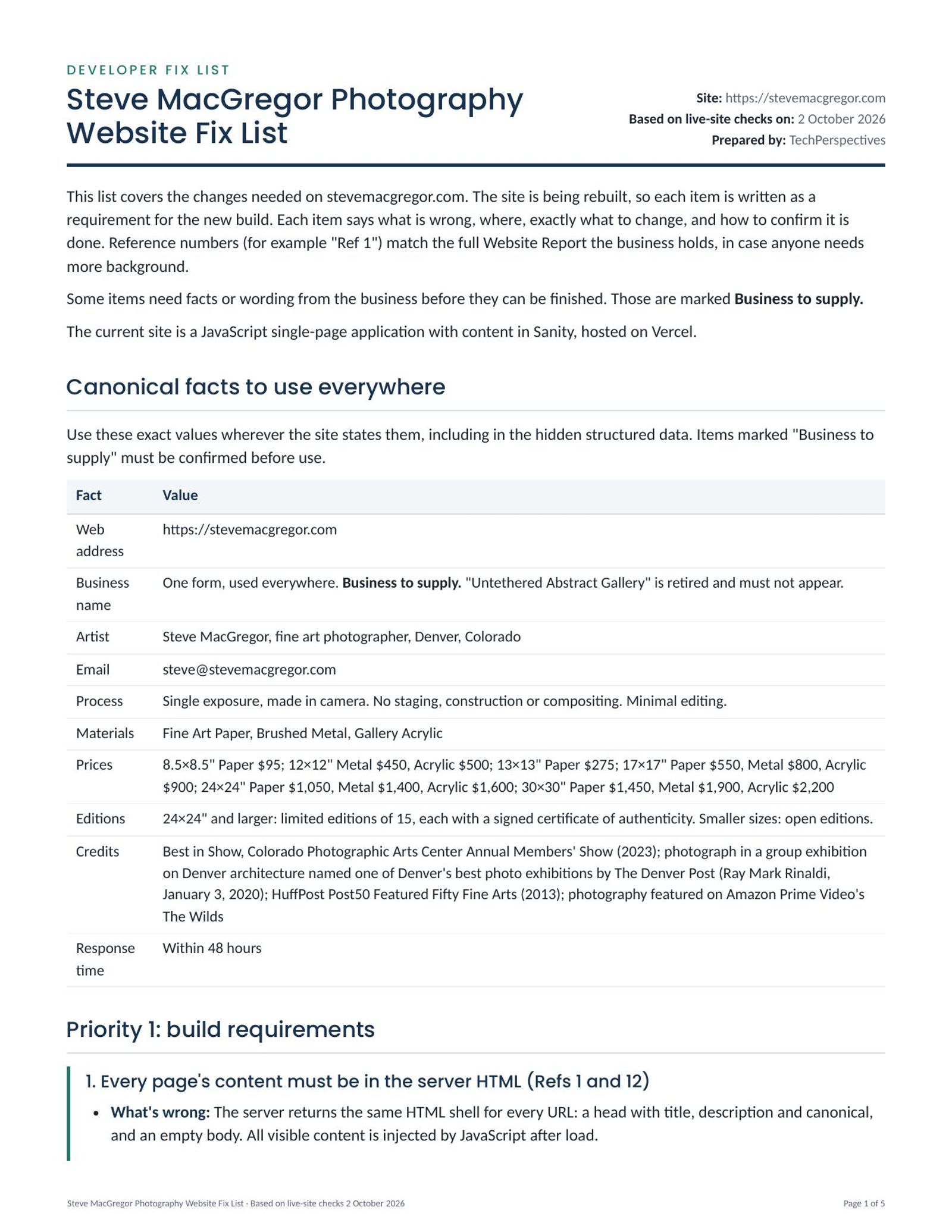
You built it. The fix list tells you what AI tools and search engines will trip on, in the order to fix it, with exactly what to change and how to know it's done.
Click any page to see it full size. From an October 2026 report. Reports keep improving, so yours will reflect the latest version. Want to see a complete report? Ask me on the call.
“I felt pretty confident that I had covered all the bases... Well, what a reality check I experienced after seeing some of the security issues I had missed... An absolute must-have, not only for optimizing your website to its fullest potential, but also for the peace of mind it will give you as a developer.”
| Developer Check | What's included | Price |
|---|---|---|
| Branded | Fix list and tracker, ranked by impact, plus one re-check of the items you fixed within 30 days. Questions by email. | $150Buy now |
| Unbranded | The same check with no TechPerspectives name, so you can hand it to your client as your own. | $200Buy now |
→Next step
Start with the free check on your own site
It takes about a minute. If the results raise questions, book a 20-minute call.